Outrage: Nestlé Buys Drought-Stricken Town’s Water Supply
Calls have come from all over the world to boycott Nestlé after the company bought a drought-stricken Canadian community’s water supply, and more than 150,000 Facebook users have taken to the social media site to voice their outrage. [1]
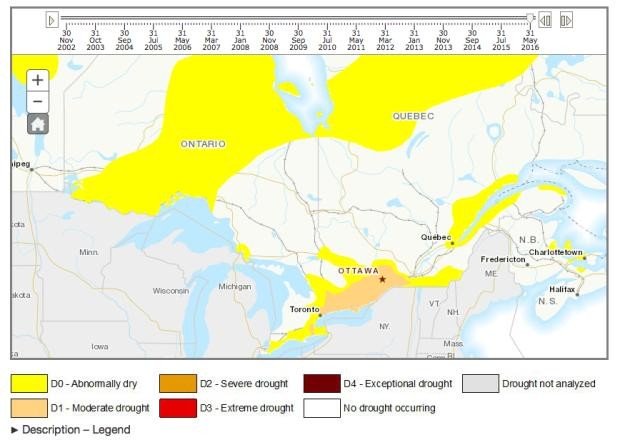
Authorities in Centre Wellington, a community in Ontario, scrambled over the summer to find a competing bid when it learned that Nestlé had put in a bid of its own on a spring water well in the region. The town’s leaders wanted to safeguard a water supply for the township’s fast-growing population of 30,000, which Kelly Linton, the mayor, says is expected to grow to 50,000 by 2041. [2]
Linton said the municipality used a numbered company to submit an “aggressive bid” for the 5-hectare site.
“We put in more money than they did and we removed all conditions.”
He did not specify the dollar amount of the bid.
Centre Wellington had forged an agreement with Nestlé 18 months earlier, giving the company the right to respond. Said Linton:
“They had the opportunity to match our offer and that’s how we lost on that on that one. As you can appreciate we aren’t going to be outbidding Nestlé. As a small town we’re using taxpayer dollars, so we have to be good stewards of that.”
Permits currently allow Nestlé to pull up to 4.7 million liters of water a day from sources in Ontario.
Nestlé claims it was not aware that the counter-offer was from the township until long after the purchase was made. In a statement, the company pointed out that the site was formerly a permitted water bottling facility, adding:
“The former owner had the property on the market for over 10 years.”
The company says it will use the site as a supplementary water source for a nearby plant in Aberfoyle that bottles 3.6 million liters of water a day. [3]
Nestlé has submitted an application to the Ontario Ministry of Environment and Climate Change to conduct an aquifer pump test, which will determine if the water source meets the company’s internal requirements “as well as ensure it can be operated in a sustainable matter.” [1]
If the water source meets these requirements, Nestlé will seek a permit allowing it to draw 300 gallons of water per minute.
A group of local volunteers, the Wellington Water Watchers, plans to block Nestlé’s plans. Said group member Mike Nagy:
“We are fighting tooth and nail to not allow that pump test to go ahead.”
Why So Much Concern?
In a Facebook post, the Wellington Water Watchers note that Nestlé’s purchase of the site will lead to a drastic increase of plastic pollution, due to the waste generated from bottles.
“Think about the plastic we will stop being produced by saying NO to the Nestlé permit renewals and the recent purchase of the Middlebrook Well. 6.4 million liters a day would translate into 12 million plastic packages per day! This is how much water they would have access to if they get the permit in Elora Centre Wellington as they already have 4.7 million liters day. Use the 4th R, REFUSE.”
The Council of Canadians is pushing for a national boycott of Nestlé. The group said in a press release:
“This summer, while many parts of southern Ontario faced drought conditions, Nestlé continued to pump more than 4 million litres of groundwater every day from an aquifer near Guelph. Nestlé pays less than $15 per day for this water, which it then ships out in hundreds of millions of single-use plastic bottles for sale all over North America.”
Council of Canadians chairperson Maude Barlow further added its 2 cents:
“The water crisis is at our door here in Canada. Groundwater resources are finite and are currently taxed by droughts, climate change and over-extraction. At this pace, we will not have enough for our future needs. Wasting our limited groundwater on frivolous and consumptive uses such as bottled water is a recipe for disaster. We must safeguard groundwater reserves for communities and future generations.”
Barlow said the new Elora well sits near a First Nations’ reserve, potentially putting their water supply in jeopardy. She added that 11,000 people living on the reserve “do not have access to clean running water.”
Much of the province of Ontario is experiencing record drought conditions. In some areas, rainfall was 100 millimeters below normal from April through June.
A History of Profit over People
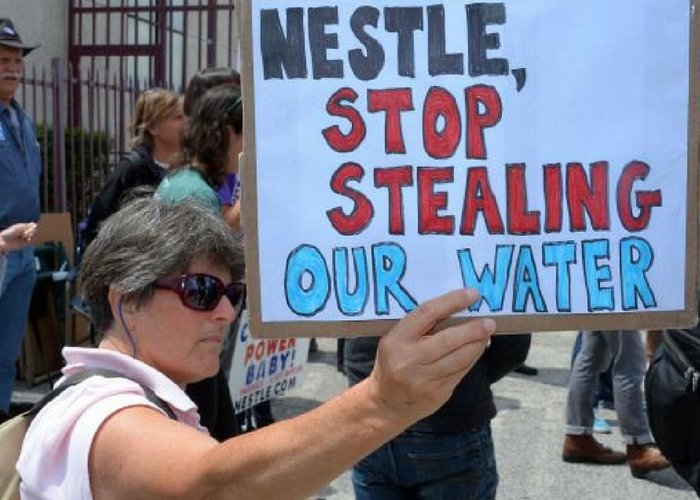
This summer, residents contended with water restrictions due to the drought. Despite the dangerously dry conditions, Nestlé continued to extract water from the Aberfoyle well. [3]
Locals claim that they are being charged more for this water – Wellington Water Watchers claims that locals pay about $1.50 per 1,000 liters of water, while Nestlé pays a mere $3.70 for every million liters.
A petition published earlier this year that currently has more than 93,000 signatures claims argues that “This commodification of a basic human necessity must stop.”
Indeed, it does. And the company has a long history of putting profits over people. Let’s take a look at Nestlé’s selfish track record.
Nestlé Head Wants to Privatize Water
Nestlé chairman and former CEO Peter Brabeck-Letmathe said in 2013 that corporations should own the world’s water supply, and that calling clean drinking water a public right was “extreme.”
You read that right: He doesn’t think water is a human right.
Brabeck-Letmathe was seen making this statement in a video titled, ” Nestlé Chairman: Water Not a Right, Should be Given a ‘Market Value’ and Privatized.”
That particular has since been removed from YouTube, but don’t fear – I found another version of it for you. The insanity begins just after the 2-minute mark.
Braback-Letmathe back-peddled after activists took him to task over his comments, and now says that water is, in fact, a human right.
Water Thieves and Deceivers
In 2014, residents of the town of Fryeburg, Maine, discovered that Nestlé had been pumping its aquifer, and then selling the water back to town residents in bottles. The realization came after locals realized that its streams were shrinking.
After locals spoke up, Nestlé embarked on an aggressive, divide and conquer campaign, suing the town and nearly bankrupting several water advocacy activists, among other things. The case went all the way to the Supreme Court.
Sadly, in May, Nestlé was granted the rights to purchase Fryeburg’s groundwater for up to 45 years.
It Gets Worse
As California struggled with its worst drought in history, Nestlé continued to extract over 80 million gallons of water from Sacramento aquifers every year. Just in like Fryeburg, the company sold it back to local residents in bottles.
This was occurring at a time when California’s water supply was expected to run out in 12-18 months, and Californians were being urged to cut their water usage by at least 20%.
Nestlé CEO Tim Brown said at the time, in 2015, that he would not apologize for the company’s contribution to California’s water crisis. On the contrary, Brown said:
“In fact, if I could increase it, I would.”
Nestlé also tapped into the San Bernardino National Forest reserve for its water, essentially stealing 1,838,451,342 gallons of water from the public trust, and then profiting from it. This resulted in activists suing the National Forest Service.
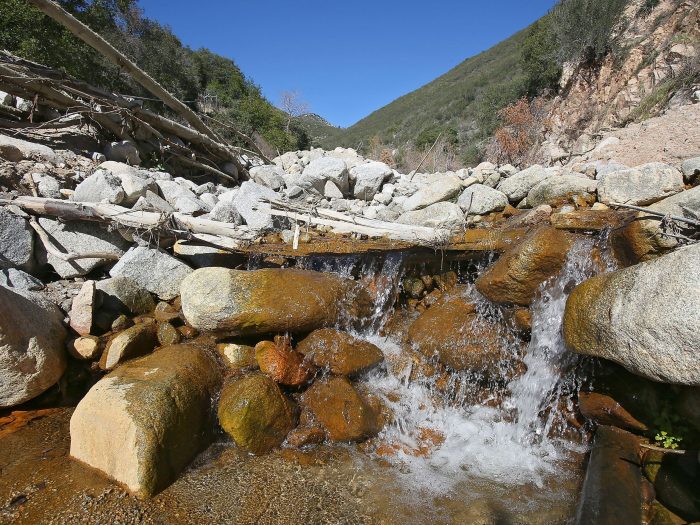
Once again, the people lost. Last week, a federal judge ruled that a 1988 permit allowing Nestlé to tap the San Bernardino National Forest for water is valid, despite the fact that the permit listed 1988 as the expiration date and was never renewed.
Money talks, and it doesn’t look good for the people of Centre Wellington.
Sources:
[1] EcoWatch (Featured image source)
[2] The Guardian
[3] Business Insider